
How to Choose a Heavy Equipment Trailer: Types, Capacity & Towing
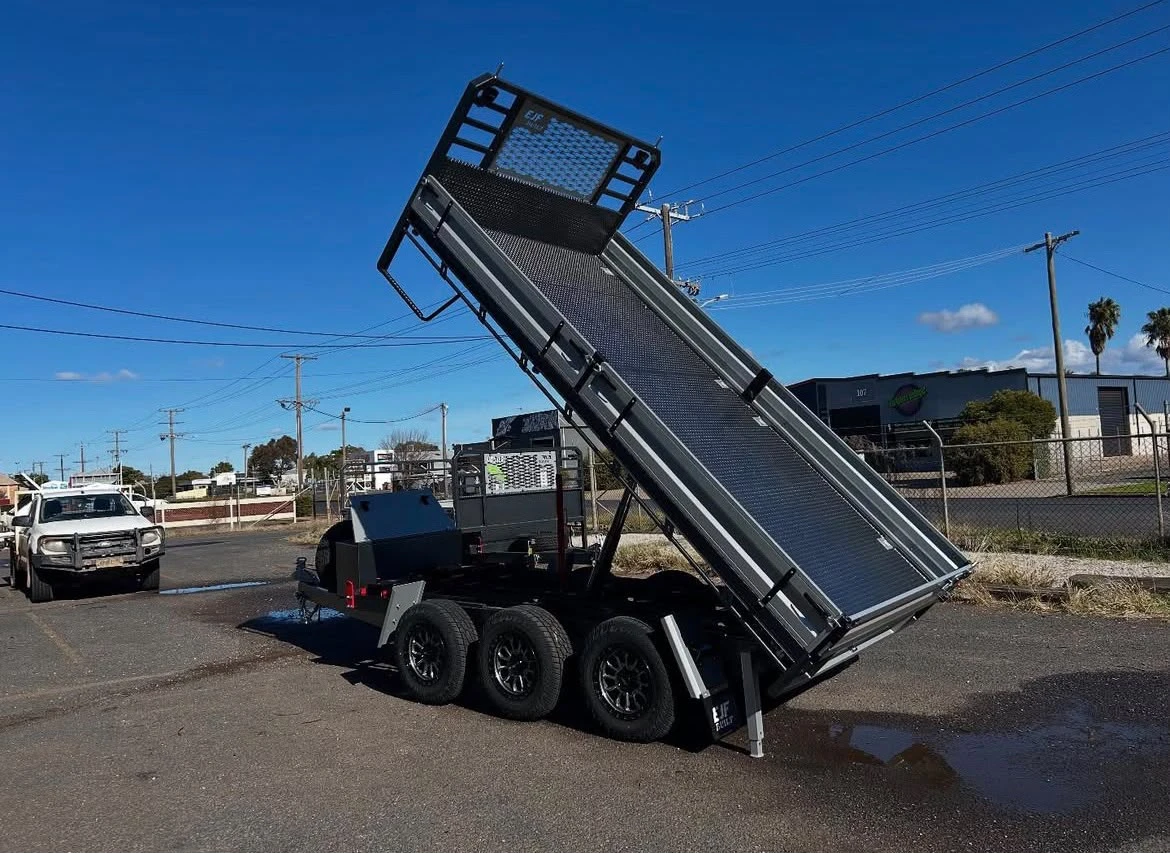
Buying the wrong trailer is an expensive mistake. If it is too small, you are overloading axles and risking fines. If it is too big, you have paid for capacity your truck cannot pull. This guide explains how to choose a heavy equipment trailer that matches your machines, your tow vehicle and the way you work.
Start here
Write down three numbers before you shop: the operating weight of your heaviest machine with attachments, the towing capacity of your truck, and the deck length you need. Every other decision follows from these.
Types of trailers for hauling heavy equipment
Tilt deck trailers
The whole deck (or part of it) tilts hydraulically or by gravity, so there are no ramps to lift. The low loading angle suits skid steers, mini excavators, scissor lifts and low-clearance equipment. Tilt trailers are popular with rental companies and contractors who load several times a day.
Bumper-pull (tag) equipment trailers
These hitch to a receiver on the truck. They are simple and work with most pickup trucks. They are best for lighter loads such as compact track loaders, small tractors and mini excavators.
Gooseneck equipment trailers
A gooseneck hitches to a ball in the truck bed, which places more weight over the truck’s rear axle. The result is better stability and higher capacity than a bumper-pull. Goosenecks are the workhorse for contractors hauling mid-size excavators, backhoes and larger loaders. See our Kaufman gooseneck equipment trailer for an example.
Deckover trailers
The deck sits above the wheels, so you get the full 8 ft 6 in (102 in) width for wide equipment and pallets. The trade-off is a higher deck, which means longer ramps or a steeper loading angle.
Lowboy trailers
For large excavators, dozers and cranes, lowboys offer the lowest deck height and the highest capacity. Removable gooseneck (RGN) lowboys detach at the front, so machines can drive on from the front. Lowboys are usually pulled by semi-tractors and often require commercial licensing and permits.
How to work out the capacity you need
Trailer capacity is where most buyers go wrong. These are the terms that matter:
| Term | What it means |
|---|---|
| GVWR (Gross Vehicle Weight Rating) | The maximum the trailer can weigh when loaded, including its own weight. |
| Empty (curb) weight | What the trailer weighs with nothing on it. |
| Payload | GVWR minus empty weight. This is how much equipment you can actually carry. |
| Axle rating | The rated capacity of each axle, for example two 7,000 lb axles. |
| Tongue or pin weight | The share of load weight on the hitch. It is typically about 10–15% for bumper-pull and about 15–25% for gooseneck trailers. |
Example: A trailer with a 14,000 lb GVWR and a 3,500 lb empty weight has a payload of about 10,500 lb. If your machine weighs 8,500 lb with its bucket and attachments, you have a reasonable safety margin. Picking a trailer that just matches the machine weight leaves no room for attachments, fuel, tools or mud.
Check your truck too
Your truck’s towing capacity, gross combined weight rating (GCWR) and hitch rating must all cover the loaded trailer. The weakest link sets your real limit.
Licensing and road rules
In the United States, commercial operators whose combined vehicle and trailer weight rating exceeds 26,000 lb, with a trailer rated over 10,000 lb, generally need a Class A CDL. Rules vary by state and by whether the use is commercial. Always confirm with your state DMV and FMCSA guidance before you buy a large trailer.
Heavy equipment must also be secured correctly. Federal cargo securement rules set out how many tie-downs you need and how strong they must be for heavy machinery. Plan on quality chains and binders, and a trailer with enough well-placed D-rings or stake pockets.
Features worth paying for
- Brakes on all axles: Electric brakes are common on gooseneck and bumper-pull trailers. Make sure a breakaway system is fitted.
- Deck material: Treated wood decks are easy to repair and give tracks grip. Steel decks last longer but can be slippery when wet.
- Ramps: Heavy-duty stand-up ramps, spring-assisted ramps or a full tilt deck reduce loading time and injuries.
- Tie-down points: Look for plenty of rated D-rings along the frame.
- Toolbox and spare tire: These save time on jobsites and roadsides.
- Lighting: LED lights last longer and draw less power.
Quick decision guide
- Machine under about 7,000 lb with a half-ton or 3/4-ton pickup: a bumper-pull or tilt trailer.
- Machine about 7,000–20,000 lb with a 3/4-ton or 1-ton truck: a gooseneck equipment trailer.
- Wide loads or pallets: a deckover.
- Large excavators or dozers: a lowboy pulled by a semi-tractor.
Buy for the heaviest machine you will haul in the next few years, not just the one you own today.
Frequently asked questions
What size trailer do I need for a skid steer?
Most skid steers and compact track loaders fit on an 18–22 ft equipment trailer. Check the operating weight with the bucket against the trailer’s payload, not its GVWR.
Is a gooseneck better than a bumper pull for equipment?
For heavier machines, usually yes. A gooseneck carries more weight over the truck’s rear axle, which improves stability and allows higher capacities.
Should I buy a new or used equipment trailer?
A used trailer in good condition can be excellent value. Inspect the frame welds, axles, brakes, wiring, deck boards and tires, and check that the title and VIN match.
Looking for the right trailer?
Tell us what you haul and what you tow with. We will point you to trailers that fit and send you a quote.